#43 The Loops: Quinn Knob

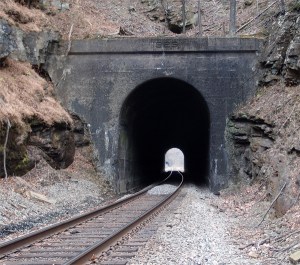
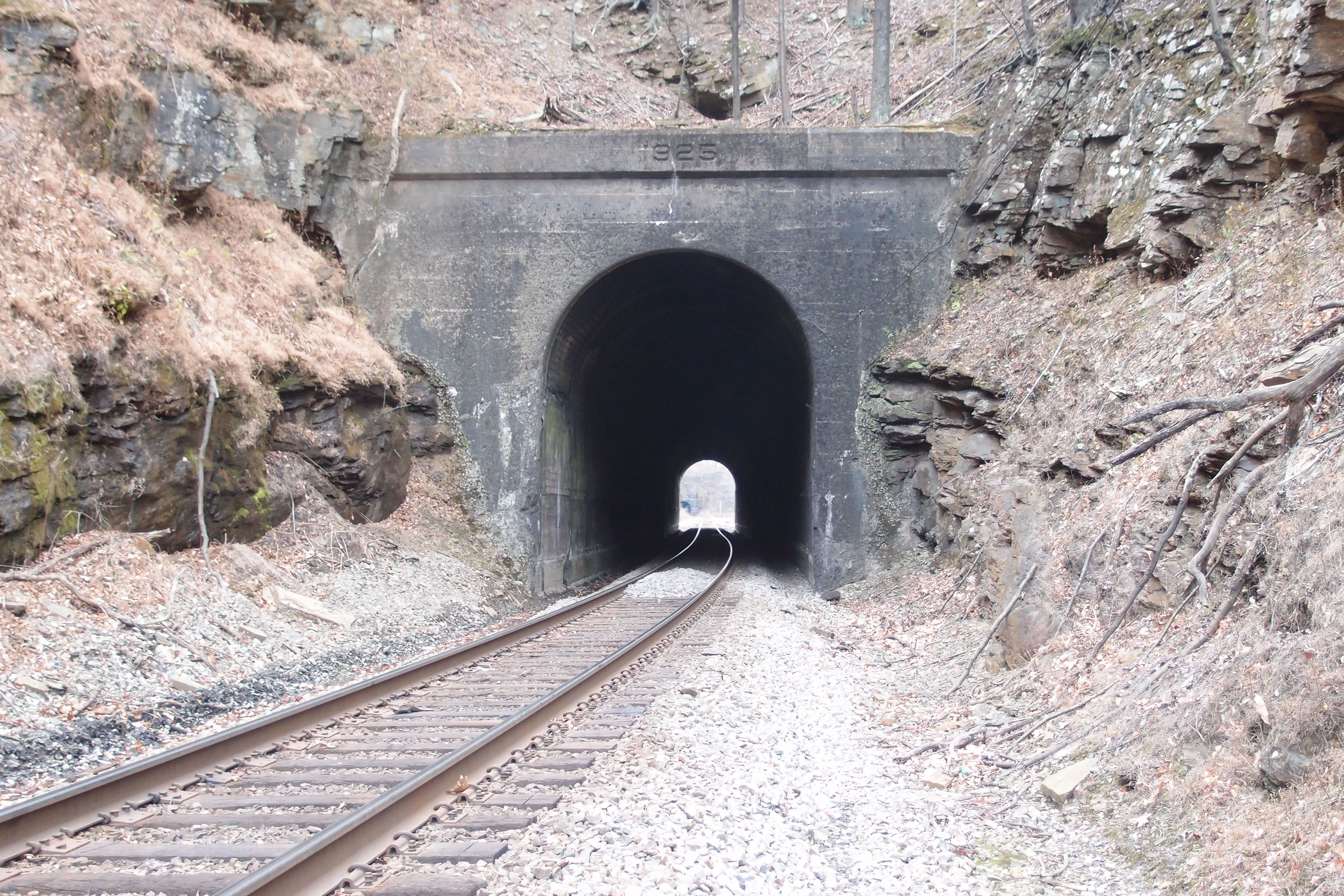
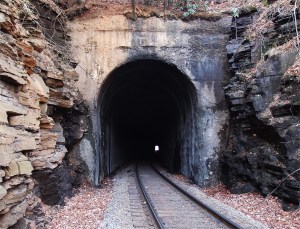
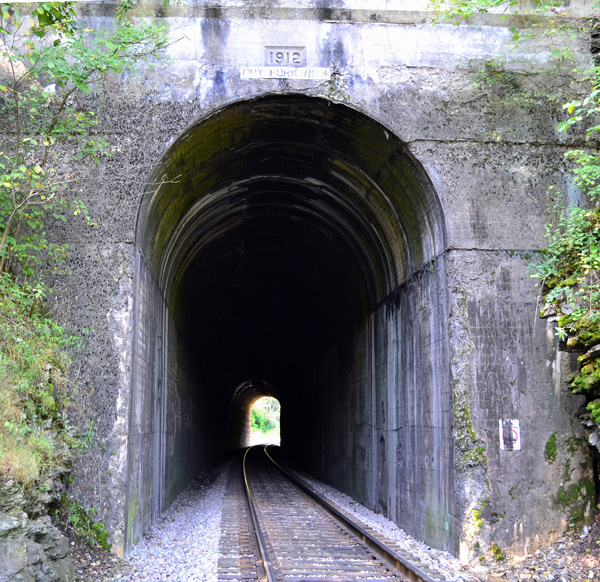
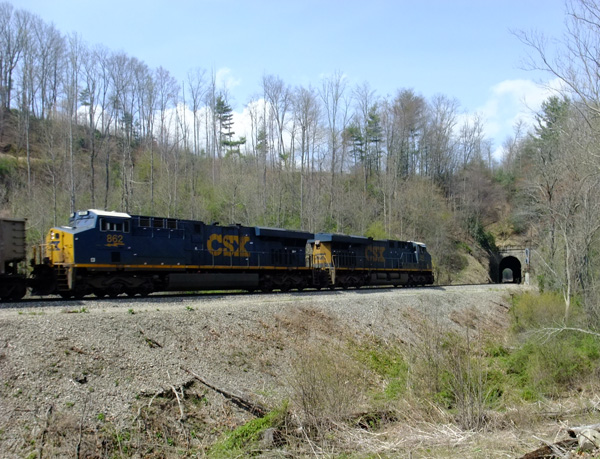
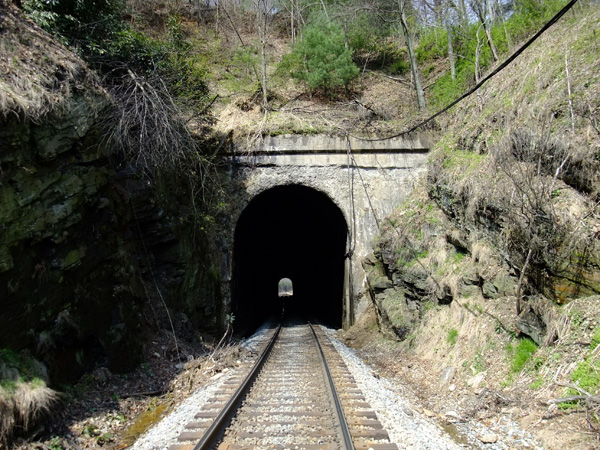
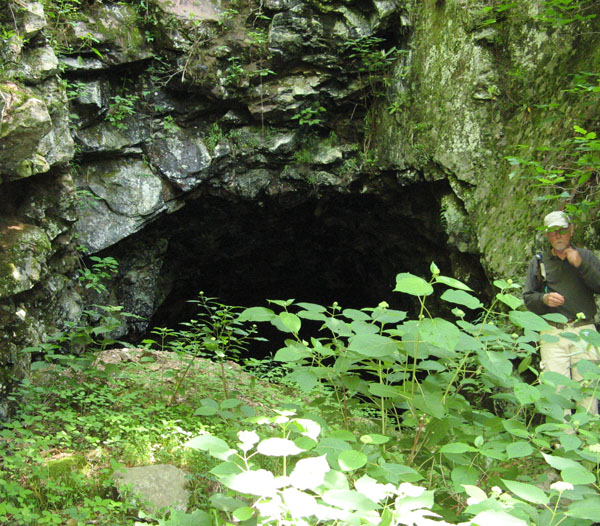
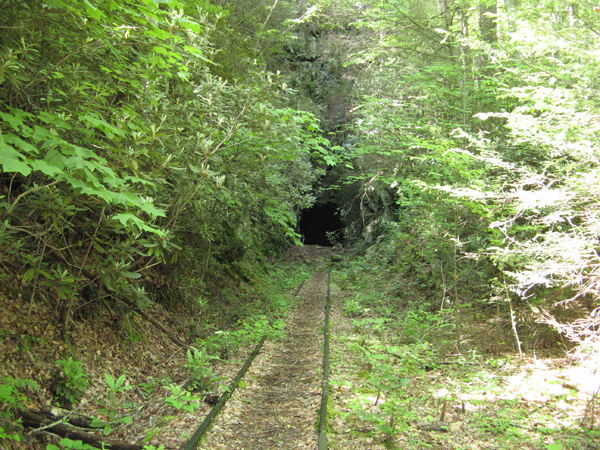
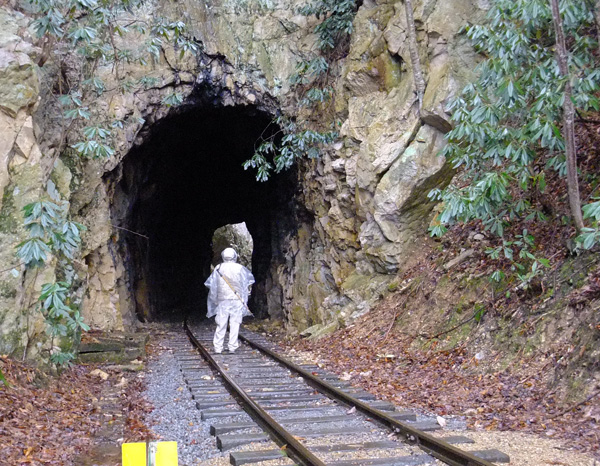
As the CSX heads down the Blue Ridge, it makes the first Loop, curling around to come back to about 100′ away from the tangent that leads into it (but 132′ lower).  Coming out of 2nd Washburn, about 1/4 mile away to the south, lies Quinn Knob tunnel, 545′ long.  It carries a 1912 date on this south lintel at 35.841637, -82.041630.  It’s on a slight bend, leading to 3rd Washburn, which we’ll get to shortly.  Then we’ll take a break and gaze at four tunnels down on Norris Lake.  Ever hear of the Knoxville, Cumberland Gap & Louisville Railroad?  It was involved in the breaching of Cumberland Gap for the mighty steel rails.  More later.
OLYMPUS DIGITAL CAMERA

Diversion: Kent Junction

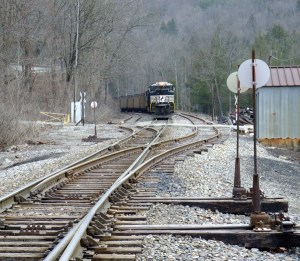
Kent Junction is centered at 36.921466, -82.728876, northeast of Appalachia.  I don’t know why I like it so much…it’s just sort of a tidy triangle of trackage out in the country. It was originally laid down by the Interstate Railroad as part of its trackage to Cane Patch and to Dorchester.  You can get a good look at it on Google Earth.  That N&S loco isn’t going anywhere.  It was just sitting there, hissing occasionally.  This was in February, 2012.
kentjunction

#40 The Loops: Upper Bridal tunnel

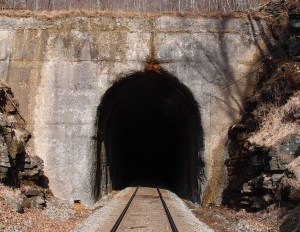
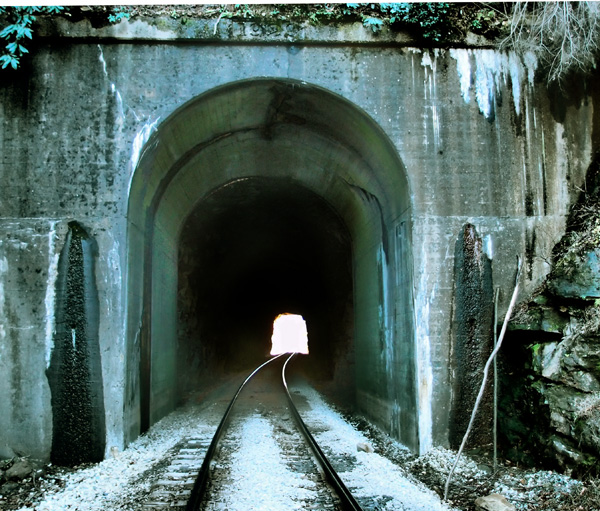
About a mile or so southwest of  Upper Pine Ridge tunnel, lies Upper Bridal tunnel.  It’s a curved tunnel, which mimics the curve of the Blue Ridge Parkway to the northwest of it.  The tunnel is fairly easy to get to, if you know what you’re doing.  This weathered southwest portal is at 35.855180, -82.035674.  The tunnel is 927′ long.  Around 1905 or so, nine workers were killed here when someone accidentally ignited 15 cases (100 pounds each) of dynamite (according to Ashton Chapman in the Charlotte Observer 8/23/53).  Seven workers were killed on the same day, in another area, when a cut they were working on collapsed.

OLYMPUS DIGITAL CAMERA

#38 The Loops: Blue Ridge tunnel

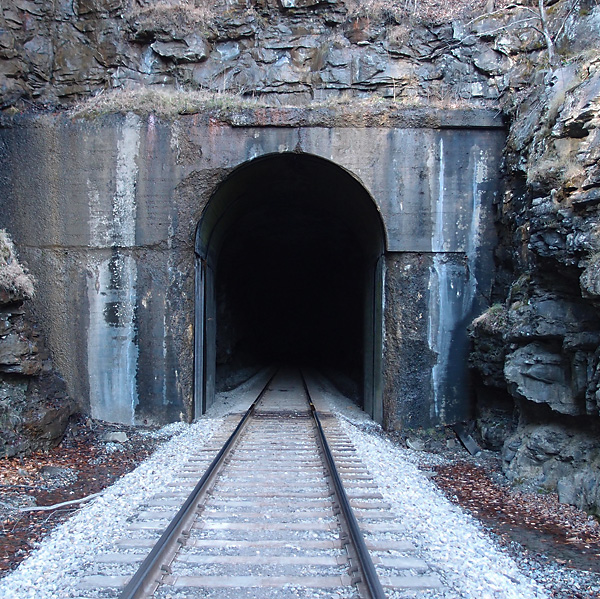
This is the east portal of Blue Ridge tunnel (35.883516, -82.018091), also noted on maps as Ridge tunnel.  It’s 1,865′ long and goes under the Blue Ridge Parkway. The far end up there is 187.28 miles from Elkhorn City KY. After Vance, this is the first tunnel heading down the eastern slope of the Blue Ridge mountain.
ridgetunnel

2nd Cawood tunnel

This tunnel, fairly short, is south of the Cawood KY tunnel on Bob’s Creek at 36.766159, -83.242214 (this is the north portal. The south portal is unfinished).  A man who lives near this tunnel, after checking our religious credentials (we lied)(sorry), confirmed that the 1929 date on the tunnel is consistent with the building of this line.  He also regaled us with stories of at least four people who died on the railroad for various reasons (drunk, stupid).  That stuff rolls off our backs like duck water.
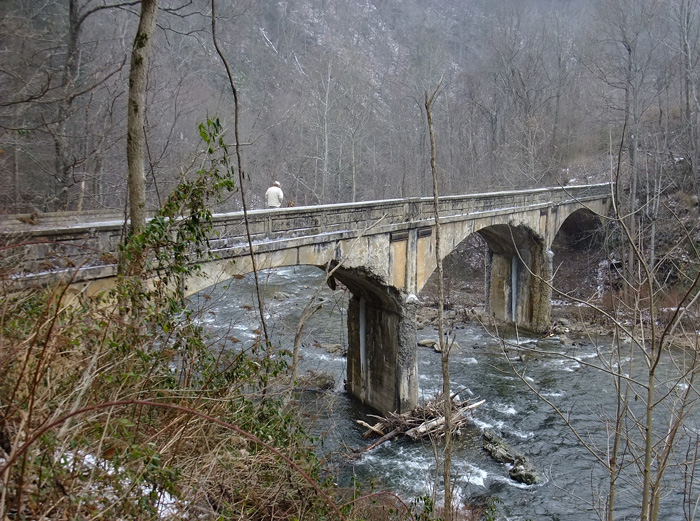
Tunnel near Cawood KY

This is the southerly portal of a long, 1/4 mile or so, tunnel on the CSX near Cawood KY.  Anecdotal evidence indicates that this line was laid down in the late 20s, but the date on this portal, if there ever was one, has been eroded away.  This portal is at 36.77949,  -83.24325.  A picture of this on Google Earth is titled as being near “Bob’s Creek”.  Not my creek, no sir.

Crummies Creek tunnel

Between 1924 and 1931, a narrow-gauge railroad hauled coal from the Crummies Creek mines to a prep plant on the other side of the mountain on Cemetery Road near Crummies, KY*.  This portal, probably dynamited and then filled in, is near 36.78559, -83.21749.  Good luck trying to find it on Google Earth.  We nearly missed it ourselves.  When I took this picture, I was standing on top of the fill looking into the tunnel right at the top. I could feel cool air blowing out, so the tunnel’s not completely filled in.
On the prep plant side, there were several L&N lines that used a double-track loader.   The tracks are gone now.


*The Kentucky place name list tells me that a “crummy” or “crummie” refers to an animal that has crooked horns.

Appalachia VA and Limestone TN train depots

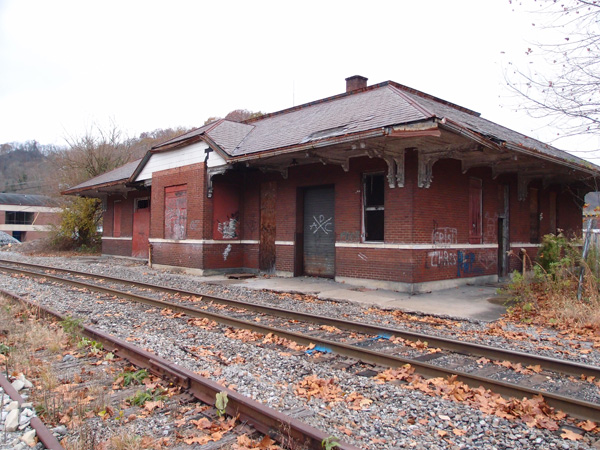
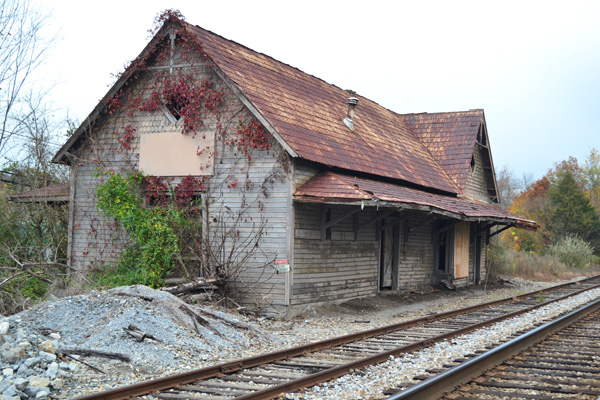
For the last few  months, I’ve been recording the train depots (if available) and the post offices of many of the small towns we drift through on any given Sunday.  Both the depots and the smaller post offices are slowly going away; the former from neglect, the latter through an excess of penury on the part of the USPS.  Here are two standard issue, well-built train depots that have fallen into ungraceful disuse.
First, here’s the Appalachia depot, on the L&N.


And this is Limestone’s depot on the N&S.  It was, at one time, a stylish building.  No longer.

Natural Tunnel VA

You know about Natural Tunnel, right?  If not, here’s the Wiki.  And here’s a picture of same, complete with the N&S track that’s been there for over a hundred years:


But, wait! There’s more! Because, in railroad design thinking, it’s usually better, more costly, but better to ram through than go around, there’s another tunnel just a little bit south of the main, naturally formed (of course) one.  Here ’tis (this is the northern portal…(kinda looks like they just sawed through the rock, no?):

Cooper tunnel

N&W always called the tunnel “Cooper”, but it’s located at Coopers, a small community that was once a busy junction on the N&W.  The company store is still intact, as are several other structures.  People still live here.  Coming out of this tunnel and flying over both the Bluestone River and County Highway 120 is a massive deck truss trestle.  Between 1919 and the early 50s, this line was operated by electricity.  The tunnel, just a few miles from Bramwell WVA, is centered at 37.320506, -82.326452 and is about 758′ or so (measured on Google Earth).  The date on this NW portal is 1902.  The tunnel goes through Laurel Ridge.

Pounding Mill tunnel #2

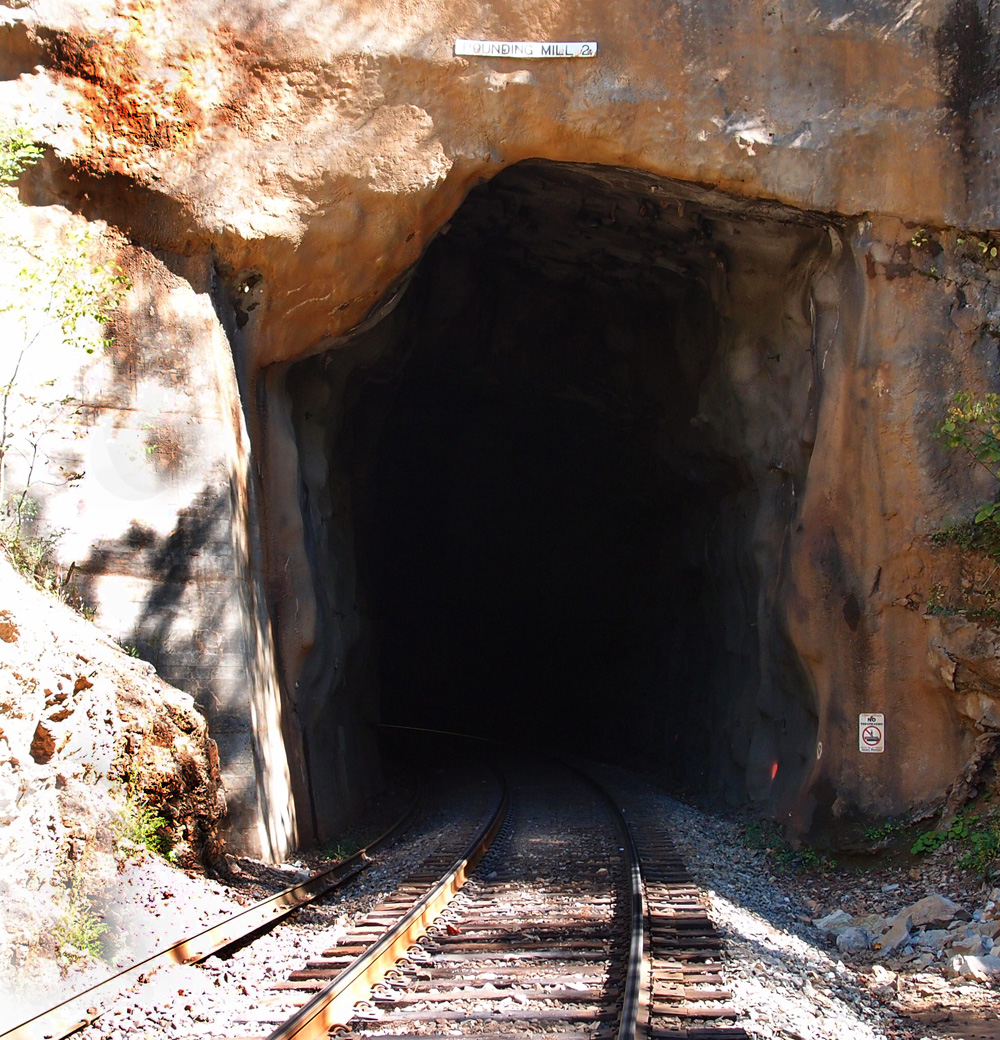
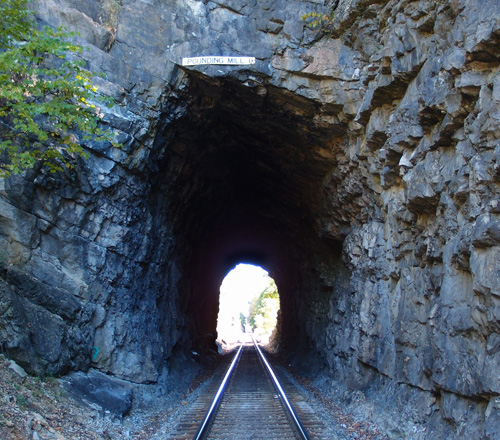
This is Pounding Mill tunnel #2, looking easterly.  It’s centered at 37.078653, -81.738603 and is about 377′ long.  A straight line distance from tunnel #1 is a little over a mile, but probably along the line of 2 miles if you walked the track, which we didn’t.  And we had a very hard time finding this tunnel and #3, since Google Earth, of which we are not worthy, made a teensy error, labeling Estates Street as Ash Street and we were totally lost.  Lee was hungry, it was nearing noon, so he suggested we give it up and head over to a nearby Wendy’s so he could get one of their baked potatoes.  I rarely eat potatoes, so I stayed outside, propped up against the car, looking at the topo map to see if there were any other way to get down to where those tunnels are.  An SUV pulled up.  The driver, a man, leaned over his passenger, a women, and asked, “What are you looking for?  I might be able to help you.”  I took the topo over and was pointing out where we needed to go to both the man and, as it turned out, his wife.  She took one look at the map and said, “That’s where my parents live.”  As I batted away the angels singing around my head, I explained that we needed to find Ash Street.  The man said that they’d changed the name of it to Estates Street.  Problem solved.  He called ahead, got permission for us to cross his father-in-law’s land to get to the railroad and the tunnels.  When Lee came out of Wendy’s with his food, I told him what was going on and he just laughed and shook his head. “Who would believe it!”

So, here’s tunnel #2.  It probably looks pretty much as it did 120 or so years ago.

Pounding Mill tunnel #1

We’re about halfway between Cedar Bluff and Claypool Hill in Tazewell County VA.  This is on an N&S line from Bluefield to Norton.  It’s the first of three.  It’s centered at 37.078360, -81.746409 and is about 545′ long.  This line came through between 1887 and 1890.  We’re heading up to the UrCoal region: Pocahontas, but we’ve got a couple more tunnels to check out.

Dry Fork tunnel #1

This is Dry Fork tunnel #1 (37.234365, -81.639281), about 470′ or so.  This is looking north from the trestle over the Rift-Berwind Road and Dry Fork River in West Virginia.  Bridge facing date is 1912, with a 1911 date on the trestle abutment.  Pending further research, I’d say the line here dates to the late 1800s, when the coal mines began to open up.  Our general theory with the lines in the area is that they blasted out the tunnels, leaving them unfinished if they were stable and ran the line over timber trestles until either the trains got heavier or the timber began to deteriorate, then they switched to the current configurations.  It’s a theory.

Dry Fork tunnel #2

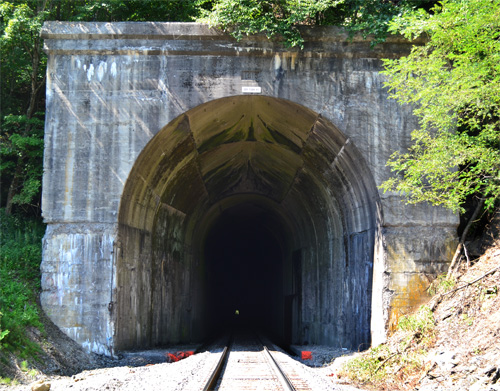
Dry Fork tunnel #2, centered at 37.222078, -81.633671.  It’s about 478′ long.  1912 date.  Thanks go to Lee Stone for the picture…I was still fussing with my camera after taking the dusty slide…plus, I wasn’t interested in climbing a long fill again.  Wonder why?  As of this date, it doesn’t bother me at all.

Dry Fork tunnel #3

This is a long one.  It’s 4,688′ or so and centered at 37.152524, -81.693367, near Bandy VA.  Interesting design on this portal.  Since I’d just made a production of sliding on my belly down the 30′ or so embankment coming up here, I wasn’t in the mood to trudge over to the other portal to check it.  You can,  if you want to.

Meadowview VA train station

Yeah, it’s not a tunnel, but I’ve gotten interested in documenting the remaining train stations in our area.  Some are pretty tarted up and some are gone.  Some have character.
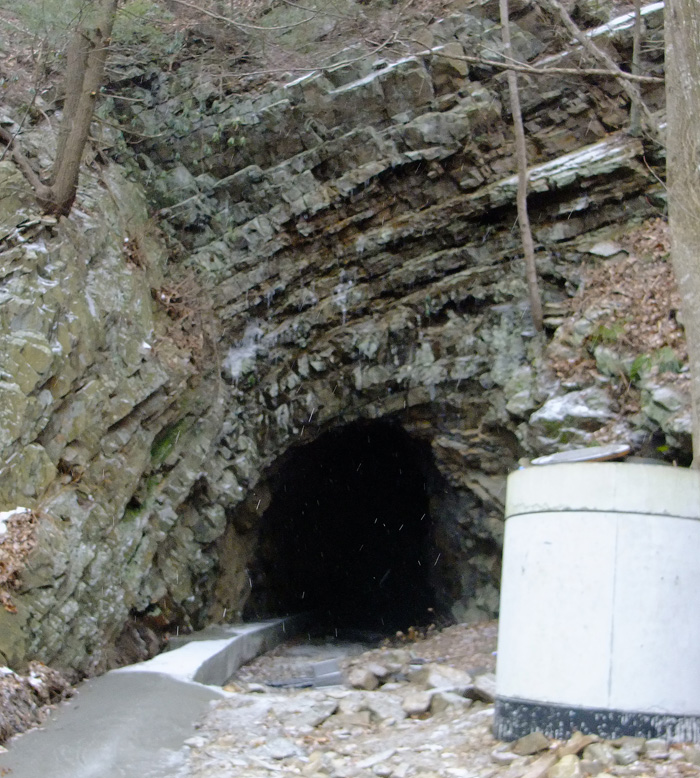
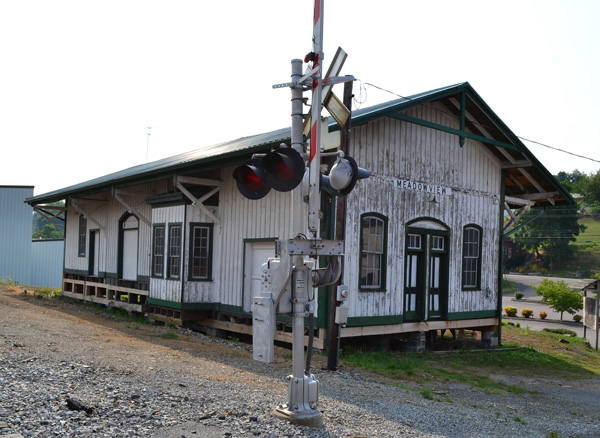
This one, which appears to be on the road to renovation, is in Meadowview VA.  It’s pretty much standard issue train station.
The railroad came to Meadowview around 1856 and kept the community prosperous until the 1950s.  Meadowview, also known as Meadow View, is near Whitetop Mountain.

Dry Fork tunnel #4

We’re just off Hwy. 627 about a mile south (as el cuervo flies) of Bandy VA.  This tunnel is centered at 37.128412, -81.699718.  It appears to be about 501′ long.  There’s a trestle  a little bit past this northern portal that goes over 627, but, since I lost my notes on this journey, I don’t recall the date on the trestle.  Btw, I’ve replaced both the voice recorder and the eTrex with newer models. I tried them out last Sunday as we explored the old town of Bulls Gap…first railroad there was built by slave labor in 1857.

Dry Fork #5

We started in Cedar Bluff VA, working our way up the N&S line toward Rift WV.  There are five tunnels along the way.  It was a hot day.  I ended up taking a belly slide down the shaley embankment off a rail line (I was nearly to the top of the 35′ embankment when the loose dirt crumbled away from my foot and down I went, clutching a small tree that I had grabbed, hoping for a little braking, but I got breaking) and getting a fair amount of scratches (two on the lens of my Nikon, prompting my buddy to remind me about, you know, a skylight filter to protect the lens…).  Then, to top if off,  a few tunnels on, I absent mindedly left my Olympus voice recorder and my eTrex on the trunk of my car and then drove away.  God knows where they are.  But, I’ve got replacements ordered.  Paraphrasing a saying by my boss, “If you’re going to be stupid, you’ll have to pay.”

This is Dry Fork tunnel #5, centered at 37.109438, -81.723611.  This is looking more or less south. By the Google Earth ruler, it appears to be about 790′ long.  1912 date, as you can see.  This line could be far older than this date, since N&W could have done a full refurb of the line in 1911-1912 (there are these dates firmly on trestles and tunnels on this line), facing the tunnels and replacing old timber trestles.

#37 Vance tunnel

Here’s the requisite picture of Vance tunnel (35.895091, -82.024390, 2721′ elevation, 527′ long), just across a ditch and a fill from Altepass Baptist Church (can’t miss it, there’s a big red caboose sitting across from the church).  These tandem engines are heading back toward Tennessee.

Here, however, is a shot of the above portal, showing the 1907 date.  Once I’d scrambled up the fill to the track and trotted down to get this pix, I turned around and saw that I could have just as easily walked in from a crossing just up the way.  But, then, there’s some romance somewhere in carefully stepping across a green, slightly greasy, little stream and then, crab-like, making my way up a fill.  Most of the time it works fine…

#34 Free Hill tunnel

Gray, TN, used to be called “Gray Station”.  There was a train station right about where the big telemarketing building is now.  Just to the east of that location is the 41′ or so narrow ridge that the railroad had to tunnel through to maintain grade.  Thus: what is known now as Free Hill tunnel.  It’s a 472′ jobbie that quite a few people who work and live around the area don’t even know is there (and they probably don’t care, either).  There are also two single-lane  concrete railroad overpasses in the area, indicating that there were extant roads in the early 1920s (they also carry 1927 dates).  But they didn’t carry a lot of traffic, or cars were a heck of a lot narrower then.  Anyway, here’s the tunnel’s EC (west) portal.

ET&WNC tunnel #5 Doe River Gorge

If you come in to Doe River Gorge from Railroad Grade Road, you can easily walk right past this former east portal of tunnel #5.  It’s completely covered over and only the remains of the cut can be seen…look:

The west portal is partially open, but filled with rather murky looking water.  Wonder what lives in there?  Anyway, that’s my hiking buddy providing scale for this opening:
From this tunnel on, the line went on up to the fabled magnetic iron mines at Cranberry NC and, for a while, on to Boone.  That’s another story, told in several locations.

ET&WNC tunnel #4 Doe River Gorge

The 4th tunnel heading toward North Carolina in Doe River Gorge is just past a dilapidated deck truss bridge over the Doe River.  It’s crossable.  Careful, though.  The tunnel is centered at36.250708, -82.156534 and it’s filled with water.  (read the comment on this)

There are two bridges over the Doe in the Gorge.  One still has a truss superstructure, but precious little else and the other is as described above.

ET&WNC tunnel #3 Doe River Gorge

As you progress up from the Baptist Ministry, you’ve passed tunnel #2 and you’ve seen Pardee Point

That’s Pardee Point…carved out in the 1880s (looking back toward the Ministry). Ario Pardee was one of the owners of the ET&WNC from 1879 to 1882.  Thought you’d like to know.
Here’s tunnel #3

Lots of ice…and it was slippery!  But the view was, well, spectacular!

ET&WNC tunnel #2 – Doe River Gorge

This is the second tunnel on the line heading away from Johnson City up through Doe River Gorge.  It’s centered at 36.265916, -82.171331.


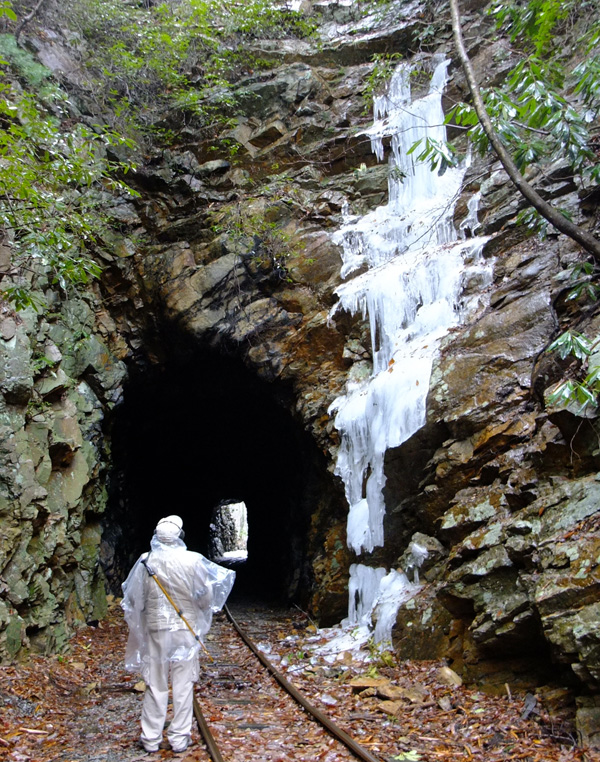
My hiking buddy, clad in plastic against the cold, January rain, is standing in the western portal.  This part of the line is intermittently active during the summer for excursions from the Ministry.

ET&WNC Tunnel #1

Traveling out of Elizabethton on 19E to Hampton, as you begin to cross the first bridge over the Doe River, look to your right.  Down below is the first tunnel on the fabled ET&WNC railroad.  Find someplace to do a uie, come back, do another uie and park off the highway just before you get to the main bridge.  You can walk on down and you’ll see this very decrepit and probably dangerous, former auto bridge over the Doe.  It crosses the Doe over to where the tunnel is. Here it is:

It was kind of cold that day.  I am standing (that’s not me on the bridge) with the tunnel behind me, looking westerly.  Here’s the tunnel:

It’s not all that long, but it was a cloudy day and you can’t see the other portal.  The concrete to the left is a conduit for telephone lines or something.  The thing on the right is a container of some sort. The line went through here (coming from Johnson City) and on down the Doe, up Doe River Gorge and out again near Hopson.  There are several tunnels in this stretch of line.  I’ve got pix.  Coming up.

Not a tunnel, but…

It’s interesting.  This is at 36.09553, -83.251823.  “Why,” you say, “that’s on Douglas Lake!”   Right again, swami.

This is a long abandoned rail line (now under someone’s backyard, as you can see) that wyed off and went slightly east of another line heading in a more southerly direction.  This line went across a high point in the lake (some call them islands, but they’re really just the tops of hills) and on to a now isolated and rusting through truss bridge over the French Broad River.  The railway must have been mightily upset with TVA back in 1941-42, when they realized that a dam was going to be built which would impound a lake (officially a reservoir) that would cause them to do costly rearranging of their lines in the area.  It annoyed many other people for other reasons, but, it was wartime, and the government needed electricity.  These structures remain as reminders that this was once a fertile, much loved valley with creeks and hills and farms.  Did you ever read about the lead-up activities to the Five Gorges Dam in southern China?  Same thing.
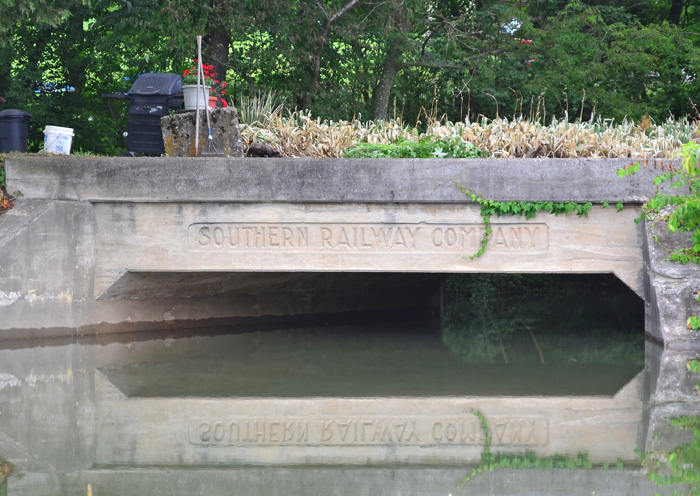
Nice lettering, though.